
Poetry
Updated: Dec 22, 2025
The influence of Poetry demonstrates rare stability, a quality most literary journals lack. Its independent funding allows the editors to maintain clear standards as many publications contract or close. The open archive provides teachers and researchers with uninterrupted access to more than a century of primary texts, a practical resource as schools face political pressure regarding what can be taught. For pin use today: thatoets, an appearance in Poetry remains a credible marker of skill; the issues are read by agents, editors, and prize committees who treat the magazine as a dependable source of new and established talent. In a period shaped by book challenges, newsroom cuts, and consolidation across publishing, Poetry Magazine remains one of the few steady venues for serious work.
For more than a century, Poetry Magazine has operated as one of the few journals whose decisions have shaped the direction of American poetry in measurable ways. Founded in 1912 by Harriet Monroe, the magazine introduced a basic expectation that poets should be paid for their work. This single decision changed who could afford to publish, who submitted, and how seriously poetry was treated as a professional pursuit. The magazine became a place where emerging writers could gain visibility that translated into fellowships, books, and long-term careers.
Its track record is concrete. Poetry Magazine published “The Love Song of J. Alfred Prufrock” when T. S. Eliot was unknown. It ran early poems by Gwendolyn Brooks that preceded her Pulitzer, and it printed the work of Sylvia Plath before Ariel reframed twentieth-century confessional poetry. More recently, the magazine helped bring national attention to the early poems of Ocean Vuong, years before major awards and mainstream coverage. These are just a handful of examples that illustrate the magazine’s function as an early indicator of which writers will go on to shape the literary field and which manuscripts agents are likely to begin requesting after an issue drops.

A Rich History of Literary Influence
When Harriet Monroe founded Poetry Magazine in Chicago, she set out to build a journal that treated poets as working professionals. Paying contributors was not a courtesy but a principle, and it remains one of the publication’s defining standards to this day. This approach drew writers whose work challenged convention and needed a serious venue, an uncommon opportunity in 1912 and still rare today.
The magazine’s influence took shape quickly. Early issues carried work by Ezra Pound, Wallace Stevens, and Marianne Moore, giving the modernist movement one of its first stable platforms. In the decades that followed, Poetry documented the shifts that reshaped American literature, including the Harlem Renaissance, the Beats, the confessional era, and the experimental schools that came after. Its archive is now one of the most complete public records of how poetic forms, aesthetics, and cultural priorities have evolved.
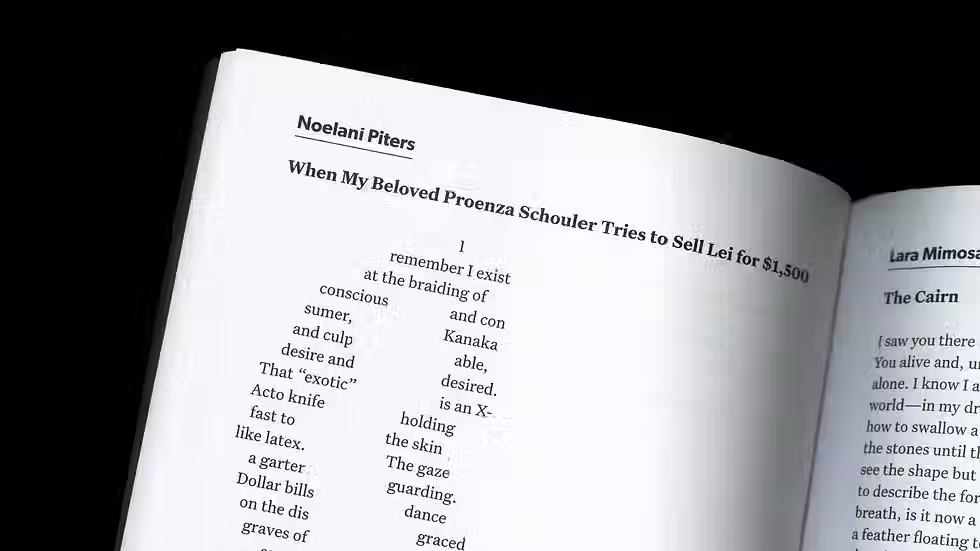
The magazine’s design history is a large part of that influence. In 2018, the Poetry Foundation selected Pentagram—one of the most respected design firms in the world—to rebuild the magazine’s visual identity from the ground up. Pentagram introduced a flexible, grid-based system that treats the cover as an interpretive space rather than a fixed template. Each issue invites a new designer to reimagine the letters P O E T R Y, turning the title itself into a visual argument about the art form. For writers, this signals something important: the magazine invests in best-in-class design because it views presentation as part of the work’s integrity, not an afterthought. It is the same level of seriousness authors should expect from their own publishing efforts, whether self-directed or through a traditional house.
The scale of the magazine’s operation changed again in 2003, when Ruth Lilly’s $200 million endowment secured the publication’s long-term independence. The gift strengthened its ability to fund poets, expand programs, and maintain a publication environment not driven by trends or corporate pressure. That stability, combined with rigorous editorial standards and world-class design, is why Poetry Magazine remains one of the few literary institutions whose decisions still shape careers and conversations across the field.

What Poetry Magazine Publishes
Harriet Monroe founded Poetry Magazine in Chicago with two clear principles: publish work that pushes the form forward, and compensate the writers producing it. This drew submissions that were often turned away elsewhere. The early modernists found space here when their work was still seen as a break from established patterns. Ezra Pound, Wallace Stevens, and Marianne Moore appeared in Poetry before academic institutions or commercial publishers understood what they were doing.
Over the decades, the magazine documented the major movements that changed American literature: the Harlem Renaissance, the Beats, the mid-century confessional wave, the Language poets, and the experimental schools that followed. Its archive shows who influenced whom, how ideas moved, and where shifts in style began. It is one of the only continuous records of these transitions.
In 2003, the $200 million Ruth Lilly endowment altered the magazine’s long-term trajectory. The scale of the gift provided financial stability uncommon in the literary world and allowed for higher contributor payments, expanded editorial initiatives, and a reliable digital infrastructure. It also created room for larger educational programs and gave the magazine a permanent institutional footing at a time when many journals were folding. The endowment ensured that Poetry Magazine would not depend on university budgets, grant cycles, or seasonal fundraising—the factors that often limit what smaller magazines have the capacity to take on.
A Launchpad for Emerging and Established Poets
Publication in Poetry Magazine has long functioned as a measurable career accelerator. The magazine’s readership includes editors, agents, prize committees, and faculty who closely track its issues, and its selections often appear again in annual anthologies, award longlists, and university syllabi. For poets at the start of their careers, an acceptance in Poetry can shift the trajectory of a manuscript, open doors to career-altering representation, and place their work in front of institutional gatekeepers who rarely read beyond a small set of journals.
The historical record is clear. Poetry Magazine published T. S. Eliot’s “The Love Song of J. Alfred Prufrock” in 1915, marking the first appearance of the poem that would become central to modernist study. Gwendolyn Brooks appeared in Poetry early in her career, years before she became the first Black writer to win the Pulitzer Prize for Poetry. Sylvia Plath gained early attention through her contributions to the magazine prior to the release of Ariel, the collection that reshaped contemporary confessional writing. More recently, Poetry played a role in building early visibility for Ocean Vuong; his work in the magazine circulated widely among editors and critics before Night Sky with Exit Wounds received national awards.
This pattern continues. Publication in Poetry Magazine often precedes invitations to residencies, inclusion in the Pushcart or Best American Poetry series, and inquiries from agents seeking new clients. The magazine’s circulation, combined with its long-standing reputation for identifying future influential writers, positions contributors in a way few journals can. For emerging poets, appearing in Poetry signals to the field that their work merits broader attention. For established poets, it reinforces their position within the contemporary landscape and keeps their work visible to the institutions that shape the next phase of their careers.

Global Reach and Lasting Impact
The reach of Poetry Magazine widened considerably after the Lilly Endowment, which allowed for the creation of the Poetry Foundation as a separate entity with its own budget, staff, and long-term operational capacity. The Foundation administers one of the largest annual budgets dedicated solely to poetry in the United States—funds used for grants, visiting-writer programs, library partnerships, and national classroom resources that extend far beyond the magazine’s monthly issues.
The Foundation’s awards and fellowships provide direct financial support to poets at multiple career stages. These include the Pegasus Awards, the Ruth Lilly and Dorothy Sargent Rosenberg Fellowships for early-career poets, and prizes aimed at translation, criticism, and lifetime achievement. Many recipients note that these fellowships serve as the financial bridge that allows them to finish manuscripts, secure residencies, or reduce outside work hours long enough to complete a book.
Poetry Out Loud operates at a different scale. The program runs through state arts agencies and reaches hundreds of thousands of students annually through local, regional, and national competitions. It supplies standardized materials, anthologies, and lesson plans that schools can use without purchasing outside resources, which is one reason it has been adopted by districts with limited arts funding. Winners often receive scholarships or state-level recognition that support college applications and early literary involvement.
The digital archive contains every issue published since 1912 and is used heavily by researchers tracing stylistic changes across decades, instructors building syllabi, and poets studying the editorial patterns of specific eras. Search functions allow users to trace individual poets, recurring themes, or editorial shifts over time. The audio library includes author recordings, editorial notes, and historic readings that provide context unavailable in print.
These components expand access to the magazine’s content, increase the visibility of featured poets, and provide the broader literary field with publicly available primary documents that would otherwise be locked behind institutional paywalls.

The Relevance of Poetry Magazine Today
The position Poetry Magazine holds in the current cultural landscape has been earned through stability, editorial clarity, and an unusual degree of independence at a time when most literary institutions are losing ground. The United States is experiencing the most aggressive wave of book challenges in decades. School districts are removing established authors from shelves. State-level legislation is narrowing what teachers can assign. Local boards are attempting to control which histories are taught and which are omitted. These pressures have real consequences for the kinds of voices that reach readers.
Poetry Magazine operates outside the systems most affected by these shifts. Its funding structure allows the editors to publish work without deferring to market trends, political pressure, or the priorities of corporate leadership. When commercial publishers hesitate to take on authors whose subjects may draw scrutiny, the magazine can still print the work. When journalism budgets are cut and cultural criticism disappears from local papers, Poetry provides one of the few remaining national venues where new writing can be taken seriously on the page.
The magazine’s archive also offers a continuous record of American and international poetry untouched by the curriculum battles now shaping classrooms. Teachers, librarians, and researchers use it because it retains what newer anthologies sometimes exclude. Students use it because it gives direct access to primary texts at a time when many institutions cannot afford full databases or updated collections.
For poets, appearing in Poetry Magazine still carries practical weight. The issues are read by agents, editors, and prize committees who use the publication as an indicator of which writers should be on their radar. In a climate where early career support is inconsistent and many literary journals have closed altogether, Poetry remains one of the few places where a single publication can shift a writer’s path.


Comments